
目次
To measure a bin liner, start with the distance around the bin opening and the depth inside the bin. The bag must open wide enough to pass over the rim, reach the base without hanging under tension, and leave spare material for folding or tying. The litre or gallon label on the bin is only a starting point. Two bins with the same stated volume can need different bag shapes.
You do not need specialist equipment. A flexible tape measure, a piece of string and a ruler are enough. If an old bag fits well, keep it as a reference. The method below shows how to measure bin liner size from the bin itself, understand flat bag dimensions and correct the common problems that make a liner slip, stretch or bunch up.
Measure the opening the bag actually has to pass over
Remove the old liner and look at the widest part of the rim. A thick lip, rolled edge or outer frame may be wider than the opening below it. Measure around that outer edge if the liner folds over it. Measuring only the inner hole can leave you with a bag that nearly fits but will not stretch over the last corner.
For a round opening, wrap a flexible tape or string around the rim. Keep it level rather than letting it slide down a tapered wall. Mark where the string meets, lay it straight and measure the length. This is the circumference that the open bag needs to accommodate. A stiff ruler across the top gives the diameter, which is a different measurement.
For a rectangular bin, measure the outside length and width of the rim. Add them together and double the result to estimate the distance around it. Rounded corners make this an approximation, so a string around the actual rim is a useful second check. On an oval or unusually shaped bin, the string method avoids making the shape more complicated than it needs to be.
Turn the rim measurement into a flat bag width
A plain bag laid flat has two sides. When opened, its mouth forms a loop, so the available opening is approximately twice the flat width. If the rim measures 100 cm around, a completely unstretched 50 cm flat opening gives essentially no spare room. You would normally try a slightly wider bag rather than rely on stretching the mouth to its limit.
This calculation is a starting point for a plain, ungusseted opening. A gusset is a folded side panel that opens out to add space. A handle, drawstring channel or specially shaped mouth can also change how the stated width relates to the usable opening. When a pack lists a width, check whether it means the folded width, the fully opened width or a dimension that includes the side folds.
Keep the units consistent. Write every dimension in centimetres or every dimension in inches before comparing bags. Ten millimetres equal one centimetre. For a clear reference on length units, see the NIST guide to SI units of length. The important habit is to put the unit beside every number on your note.

Allow for the base, the cuff and the final closure
Measure from the rim down to the inside bottom of the bin. Then consider the base shape. A flat bag must open out across that base before it can lie against the walls. Its full flat length is therefore not all available as straight vertical height. The wider the base, the more this difference can matter, especially in a broad, shallow bin.
Add usable material above the rim for the way you close the bag. A folded cuff needs enough length to stay in place while the bin is used. A flat-top bag needs a free neck if you tie a knot. A drawstring bag needs enough access to gather the opening and pull the cords without the contents pressing hard against them. There is no single extra length that suits every closure and bin.
A liner that appears long enough when empty can pull off the rim as soon as rubbish settles into its bottom. This often happens when the bag hangs from the cuff rather than resting on the base. Push the empty liner gently into the bottom before judging the fit. If doing so drags the cuff below the rim, choose more usable length.
Work through a round-bin example
Imagine a round bin with an outside rim circumference of 94 cm and an inside depth of 45 cm. Half of 94 cm is 47 cm. That gives a useful lower reference for the flat opening of a simple bag, but a 47 cm mouth would have no allowance for passing over the rim comfortably. Start your sample check with a bag whose usable opening is wider.
Next, try its length in the empty bin. Ease the bottom down so it rests naturally, smooth the sides and fold the cuff over the rim. Check that you have enough material left to gather the neck later. These are illustrative measurements, not a specification for a Zhaosen product or a promise that one printed bag size will fit every bin with a 94 cm rim.
If you only know a round bin’s diameter, the circumference is approximately the diameter multiplied by 3.14. A 30 cm diameter gives roughly 94 cm around. Use the diameter of the part the bag must pass over, including a projecting lip. Measuring around the rim with string is still a sensible final check because handles and rim shapes can alter the practical fit.
Check a rectangular or pedal bin differently
For a rectangular rim measuring 32 cm by 24 cm externally, the approximate perimeter is 112 cm. Half that perimeter is 56 cm. Again, this is a plain-mouth reference rather than a guaranteed purchase size. A bag may also need room to turn around pronounced corners without becoming tight along one side.
A removable inner bucket should usually be measured on its own if that is where the liner sits. The decorative outer body can be much larger. Check where the bucket’s carrying handle rests, whether a retaining ring holds the cuff and whether the bag needs to pass through a small holding slot. These details change how spare material can be folded out of the way.
For a pedal bin, close and reopen the lid with the empty liner fitted. A bulky cuff can catch in the hinge or prevent the lid from sitting flat. If the opening fits but the folded material gets in the way, first arrange the cuff evenly and use the retaining feature as intended. A different bag length or mouth shape may be more helpful than simply buying a larger bag.
Use a fitting problem to identify the next measurement
Watch where the bag becomes tight. A mouth that will not pass the rim points to opening width. A mouth that fits until you push the liner to the base points to usable length or base shape. A bag that reaches the bottom but leaves a large bundle under the lid may be too long or poorly arranged. These problems need different corrections.
Do not treat every slipping liner as a thickness problem. A thicker film can still have the wrong dimensions. Similarly, an enormous bag may fit around the rim but produce folds that trap rubbish or make tying awkward. Adjust the dimension connected to the symptom before changing several things at once.
| What you notice | Check first | Practical next step |
|---|---|---|
| Mouth will not go over the rim | Outer rim perimeter and usable opening | Try more opening width or a better matched mouth shape |
| Cuff slips when the bottom settles | Usable length and base reach | Choose enough length for the bag to rest on the base |
| Lid catches the folded plastic | Cuff position and spare length | Refit the cuff, then reassess length and closure style |
| Too little space left to tie | Filled height and closure allowance | Stop filling earlier or use a longer suitable liner |
| Much unused plastic bunches inside | Width, depth and the actual inner bucket | Measure the working bucket rather than the outer shell |
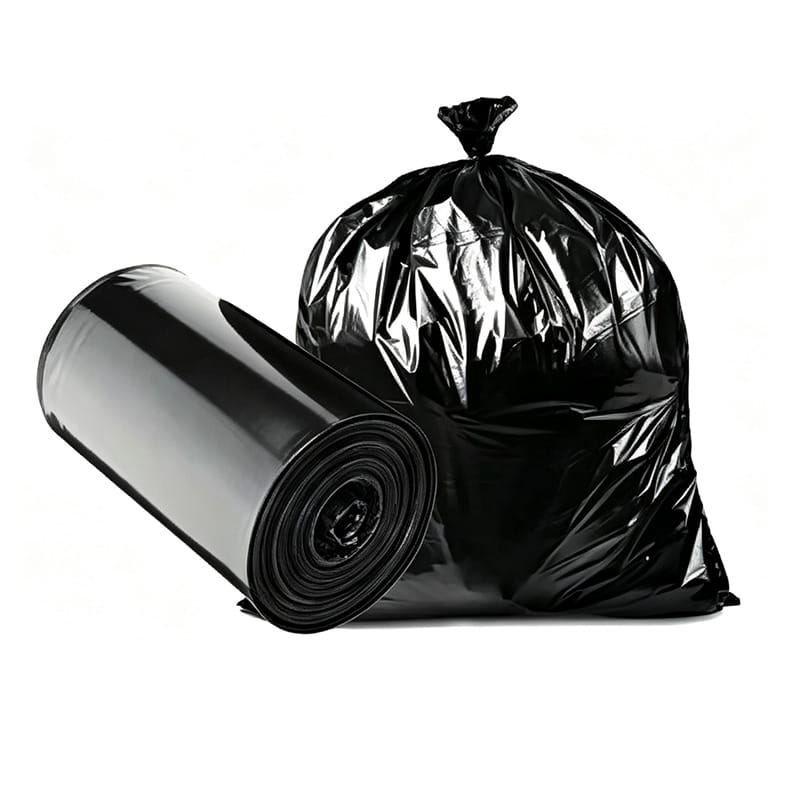
Try an empty-bag fit before making it your usual size
Use one clean, empty bag for the first trial. Fit it to the rim, let the bottom reach the base and operate any lid or retaining ring. Look for tension across corners, a suspended bottom or folds blocking the hinge. You can learn more from this short check than from the volume printed on two different bin labels.
During ordinary use, leave room at the top and observe whether the cuff stays in place. Do not fill the liner with water or deliberately overload it to prove the measurement. Fit and strength are separate questions. A correct fit does not make an ordinary liner suitable for sharp objects, unusually dense waste or any material that requires a different disposal container.
When a sample fits, write down the actual flat dimensions, mouth style and the bin it fits. Keep the packaging label or photograph it. If you later change from a flat top to drawstrings, repeat the check rather than assuming the same printed dimensions behave identically. The closing channel can use space differently.
Keep a short size note instead of guessing again
A useful note can be as simple as: kitchen inner bucket, 112 cm around the outer rim, 44 cm inside depth, fitted sample dimensions, and enough free neck to close. Add whether a retaining ring or pedal lid is involved. This gives you a repeatable way to compare the next roll without storing a cupboard full of almost-right sizes.
If your bin has an unusual opening, compare the available star seal garbage bag formats or discuss the measured shape through Zhaosen’s custom packaging options. The most useful information is the rim measurement, inside depth and preferred closure, followed by a simple fit trial.
The final choice should feel unremarkable in daily use. The liner opens over the rim without a struggle, reaches the base, stays clear of the lid and leaves room to close. Once you know how to measure bin liner size this way, the bag’s volume label becomes a secondary check rather than the only reason you choose it.
Have an awkward bin shape? Use the form below to share its rim measurement, inside depth and preferred closure so the available bag options can be checked.
Can I choose a liner from the bin’s litre capacity alone?
Use capacity as a rough starting point. Measure the rim and inside depth because bins with the same stated volume can have different proportions.
Is flat bag width the same as the width of an open bag?
No. A plain flat bag opens into a loop approximately twice its flat width. Gussets, handles and drawstring channels need separate interpretation.
Why does a liner fit the rim but slip down later?
The bag may not have enough usable length to rest on the base while retaining a cuff. Recheck the base reach before changing thickness.
Should I measure the outside body of a pedal bin?
Measure the inner bucket or frame that actually holds the bag. Then check the lid, hinge and retaining ring with an empty liner fitted.
How much spare bag should I leave for tying?
Leave a free neck that you can gather and close comfortably. The needed amount depends on the closure, bag shape and the way the bin is filled.